
Labor says ‘global reckoning’ coming for big tech
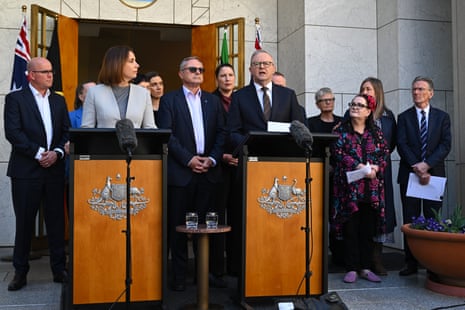
Anthony Albanese says the digital duty of care bill will give people control over their social media, and require tech platforms to “protect children from harmful content, including content that promotes eating disorders, misogynistic content, pornography, and content that glorifies crime”.
Albanese is joined by communications minister Anika Wells, as well as a group of advocates who have been pushing for digital safety.
The prime minister says the bill is not about government control, and adds tech giants could face penalties of more than $100m for breaches.
[This legislation] will require social media platforms to provide user empowerment tools that give people over the age of 16 genuine and enduring choice about what they see in their feeds.
We’ll provide e-safety with the power to issue removal notices for nudify apps, all websites, and streamline the child cyberbullying and adult cyber abuse schemes, and will require digital platforms to document the measures taken to address harm to Australian users, and ensure measures remain effective over time.
This is sensible, pragmatic, practical reform. It gives users choice, and it will hold the big tech companies responsible for inaction.
This is not about giving government control. It’s about giving people control.
Wells says:
Tech companies have been running real time, unregulated product testing on Australians, and their platforms and tools have infiltrated our daily lives in ways that we could never have imagined.
This is a global reckoning coming for big tech.

Key events
Opposition playing ‘follow the leader’ on tobacco excise, Butler says
Angus Taylor gets on to the wedge train and tries to pressure the government over comments from NSW Labor premier Chris Minns again, this time on the tobacco excise.
This morning Minns (who has publicly questioned the efficacy of the excise remaining high) said: “It’s perversely driving a situation where you’re seeing more people, not less people, smoking because they’ve got access to readily available cheap [black market] cigarettes.
The health minister, Mark Butler, says the government is “not interested in joining the Coalition, in following the leader, that he pathetically appears committed to be playing with the One Nation party”.
We’re not interested in joining the Coalition in a price discounting war with organised crime.
We won’t be joining in a policy plucked out of thin air, with one apparent objective, to go a little bit further than One Nation … And the member for New England [Barnaby Joyce] is pumping his fist. He knows what’s going on here. They know this follow the leader game that he’s playing.
In the middle of his answer, Labor MP Matt Burnell gets kicked out for shouting too much.
Independent MP calls for additional doctors in western Sydney
Over to the crossbench, Dai Le asks if the government will review a mechanism that means her western Sydney community of Fowler doesn’t get “distribution priority area” status and can’t get additional doctors into the area.
The health minister, Mark Butler, spruiks the government’s Medicare urgent care clinics and the increased number of students training to be doctors.
Le makes a point of order, and says Butler is not addressing whether her area can be reviewed to access more support.
Butler says the issue “is not particularly simple” and won’t commit to changes, just that he’s happy to engage with Le.
Generally, distribution levers have distinguished pretty sharply between the big cities and rural and regional Australia so that doctors coming from overseas, which is the question the member asked, are required to practise for 10 years in rural and regional communities. Now, there’s parts of particularly outer suburban Australia, who are really struggling. Who have lower doctor rates per head of population than many parts of regional Australia. And we are grappling with that question.
Every time we have an overseas doctor going to the cities, rural communities complain that’s taken from them. Happy to engage with the member more about that. It’s not particularly simple, though.
Albanese says he has a few facts to provide the opposition on housing
Liberal frontbencher Melissa McIntosh is next and asks the prime minister if he agrees with NSW premier Chris Minns that Labor’s housing taxes mean less construction and fewer homes in Australia.
She adds, “since Labor’s budget, 421 New South Wales building companies have gone broke. Including Bathla Group, risking 14,000 affordable homes and apartments.”
Anthony Albanese says he has a few facts to provide the opposition:
Fact one, the latest ABS data shows that under this Labor government the total value of housing in Australia has gone from $10.1tn to 12.7tn, an increase of some 26% in just four years. Fact two, the median national house price in August was higher than it was a year ago.
McIntosh raises a point of order and says the PM isn’t addressing her question which is whether he agrees with Minns or not.
There’s some back and forth here, including an accusation that Albanese dismissed McIntosh with a flick of his hand.
Albanese continues with some more facts, and says Labor is giving young people a crack at housing:
Fact seven, annual construction cost inflation has fallen from a half-century high, under the Coalition, it was 17%. Today, it’s 3.8% under Labor.
It’s question time!
Shadow treasurer Tim Wilson, is first up at the dispatch box today and asks if the government will confirm it’s on track to miss its housing build target by at least 300,000 homes (“woah” shout the opposition members).
Wilson attributes it to toxic taxes delivering “a trifecta of housing failures. Fewer homes, higher rents, and confidence in the Australian housing market smashed.”
The government had promised to build 1.2 million homes over five years to mid-2029.
The housing minister, Clare O’Neil, says the housing crisis has been cooking for more than 40 years and then goes into a bit of a compare and contrast with the opposition’s policies.
The combined effect of our supply measures as a government is going to build an additional 400,000 homes for Australians, a big part of that, Speaker, is our push on social and affordable homes. We have a fundamental belief on the Labor side of politics that the government has got to be involved in the task of housing Australians. Now, that 55,000 Speaker, we had a question here that relates to supply, do you remember how many homes they built, in nine years of government? 373 homes.
Wilson then makes a point of order and says O’Neil isn’t answering the question. Speaker Milton Dick tells the minister not to “stray” into too much talk about the opposition.
O’Neil won’t confirm the opposition’s number and spruiks the government’s housing targets and policies like previously increasing commonwealth rent assistance.
In pictures: protesters rally for justice for Zomi Frankcom outside Israeli embassy
Protesters are outside the Israeli embassy in Canberra today, demanding justice for Zomi Frankcom, the Australian aid worker killed in Gaza after the Israeli Defence Force struck an aid convoy.
The rally was attended by politicians including Greens deputy leader Mehreen Faruqi, and independent senator, Lidia Thorpe.
Albanese dodges question on UK banning commercial activity with Israeli settlements in the West Bank
Anthony Albanese takes a final question on whether Australia will follow the UK’s lead and implement a ban on trade with Israeli settlements in the West Bank.
The prime minister doesn’t weigh in on whether Australia would do the same, and says broadly:
I’ve made clear on a number of occasions, we support a two-state solution in the Middle East. We think that is important for both Israelis and Palestinians to be able to live in peace and security.
Choice between algorithm opt-in/opt-out is ‘empowering’, Wells says
Anika Wells says the government’s position is a middle ground between an opt-in and opt-out model for algorithms.
The communications minister says there will be a “pop-up” notification that will ask users if they want platforms to use an algorithm or not.
The government’s statement explaining the draft legislation says:
Users can choose to opt in to having their default feed include personalised content recommended by the algorithm. Alternatively, users can opt out of personally recommended content in their default feed and see the friends and creators they choose to follow.
Wells tells the press conference that this makes it a “neutral choice” for users:
You will have a choice about whether you want the algorithm or whether you want the following feed. That is a neutral choice that Australians will be able to make. It’s empowering.
And the reality is lots of people are going to want to choose the algorithm. Lots of people follow it for entertainment, lots of people follow it because they like supporting small local business in their suburb.
The prime minister adds later that if people want to continue doom scrolling, well that’s their prerogative.
If people want to doom scroll, as you call it, that’s fine, that’s up to them.
Six serious harms banned for kids under Labor’s digital duty of care bill
My colleague, Tom McIlroy asks Anika Wells how the government will stop “mission creep” around these rules and stop political content being drawn into the bill.
The communications minister says there are six serious harms that are outlined under the bill for kids, while for adults there will be a ban on “just illegal content”.
Digital platforms will be required to protect kids from serious harms including:
There are six of those, which is content around the promotion of eating disorders. So like I said, a chatbot giving a teenage girl advice about how to exist on 600 calories a day. Misogynistic content that promotes hostile attitudes towards women, so that might be a particular platform, circulating content that women or girls are equivalent to beasts or animals. Pornography, content that glorifies crime or dangerous stunts, so, you know, there’s people at the moment that still can circulate that footage online.
And then content that causes serious distress, and that includes abuse and cyberbullying, so that is like a chatbot, telling a teenager how to self-harm. So these are all things that the esafety commissioner currently grapples with and has for some time, but we are making those the six serious harms that will be regulated for Australian children.
For Australian adults. It’s just illegal content.
Albanese ‘emphatically’ rules out censoring political statements on social media
Anthony Albanese is asked about concerns that the duty of care bill could amount to political censorship. Critics have claimed Labor is trying to use the legislation to shut down criticism of the government.
The prime minister says he can “emphatically rule that out”.
He says the bill is not about government control, but individual control.
It’s not about censorship. It’s about giving people control themselves over what they see. We can emphatically rule that out. This is about basic safety standards online for online services and about the onus being on big tech to identify risks on their platform and to mitigate against those risks.
Wells is also asked whether she will have the power to designate new forms of harm, she says:
The rule making power exists elsewhere in the Online Safety Act. I used it, you’ll recall, to include YouTube in the social media minimum age laws when I became the communications minister, that would have been disallowable in the Senate. Nobody disallowed it in the Senate.
Labor says ‘global reckoning’ coming for big tech
Anthony Albanese says the digital duty of care bill will give people control over their social media, and require tech platforms to “protect children from harmful content, including content that promotes eating disorders, misogynistic content, pornography, and content that glorifies crime”.
Albanese is joined by communications minister Anika Wells, as well as a group of advocates who have been pushing for digital safety.
The prime minister says the bill is not about government control, and adds tech giants could face penalties of more than $100m for breaches.
[This legislation] will require social media platforms to provide user empowerment tools that give people over the age of 16 genuine and enduring choice about what they see in their feeds.
We’ll provide e-safety with the power to issue removal notices for nudify apps, all websites, and streamline the child cyberbullying and adult cyber abuse schemes, and will require digital platforms to document the measures taken to address harm to Australian users, and ensure measures remain effective over time.
This is sensible, pragmatic, practical reform. It gives users choice, and it will hold the big tech companies responsible for inaction.
This is not about giving government control. It’s about giving people control.
Wells says:
Tech companies have been running real time, unregulated product testing on Australians, and their platforms and tools have infiltrated our daily lives in ways that we could never have imagined.
This is a global reckoning coming for big tech.
Your questions answered in our brand new political newsletter – Politics, really:
Have a question about the news you’d like answered by Guardian Australia’s politics team in Canberra?
This week our team has been reporting on the government’s soon to be released digital duty of care bill. It’s a policy that will impact almost all Australians as we increasingly live our lives online.
If you have thoughts or questions about how it will work, or why the government is continuing its regulatory agenda against big tech, please write in.
We have also reported on everything from superannuation to US bases on Australian soil – if you have a question about any of those topics, we’d love to hear it too.
Send us an email at politicsreally@theguardian.com, and don’t forget to sign up for the newsletter.


