
Swedish PM Kristersson resigns after election defeat
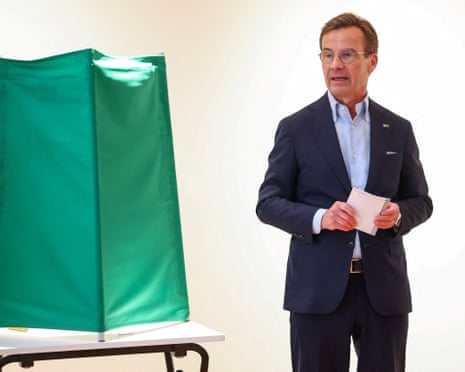
And in the last few minute, Sweden’s prime minister Ulf Kristersson has resigned from the post after official results confirmed that his right-leaning bloc lost last Sunday’s parliamentary election.
The four left-leaning parties, with former prime minister Magdalena Andersson’s Social Democrats as the largest party, won by just 50,359 votes, the final count showed.
The four left-leaning bloc will have 176 seats in the new parliament to 173 for Kristersson’s three-party coalition government and the far-right Sweden Democrats who were expected to join the administration after the vote, the Tidö bloc.
In a letter posted on X, Kristersson said that following the tight election results “may have complicated the conditions for the new government to be formed” with contradicting statements from different parties on their positions.
“Constructive openness from the parties in parliament will now be needed for a prime minister to be accepted, and for a new government to be able to receive support for its state budget.”
“Discussions will need to be held with all parties to find ways around these deadlocks and to create the conditions for a stable and effective government.
“It is the speaker who will lead the next steps towards forming a new government. In order for that work to begin immediately, I hereby request to be relieved of my duties as prime minister.”

Key events
-
Kristersson’s language suggests he still hopes left-leaning bloc will fail to form government – snap analysis
-
Timeline for next steps after Kristersson’s resignation – snap analysis
-
Swedish PM Kristersson resigns after election defeat
-
Q: What explains some pro-Russian sentiment in Germany?
-
Q: What are we expecting from progressive parties in this weekend’s state elections?
-
Q: What is the German media landscape and how is AfD treated?
-
Q: Why is Merz seen as a very reluctant critic of the US?
-
Q: Is AfD going to get electoral success again in near future and what options Merz has to resist?
-
Q: Is there anything that could stop AfD winning power in 2029?
-
Q: Will Merz deliver on reforms he promised before 2025 election?
-
Q: Who could replace Friedrich Merz and what would it mean for Germany’s international commitments?
-
Q: Could Friedrich Merz be out of job after this weekend?
-
Q&A with Deborah Cole: Your questions on Germany, Merz and what’s coming next
-
Closer ties with EU will ‘make Canada stronger,’ Carney says, as he rejects Trump’s criticism saying ‘no one’ can ‘dictate … with whom we can strike agreements’
-
‘What matters is the substance,’ Carney says, as he waves away questions about ‘associate membership’
-
Carney calls for closer ties between Canada and EU in contrast to increasingly assertive superpowers – summary
-
Carney calls for ‘transatlantic forest’ of values and free people
-
EU-Canada alliance not meant to ‘propose third bloc, a great power rival, only with better manners’
-
Carney calls for closer strategic autonomy, trade, student mobility ties with Europe
-
Carney welcomes suggestion Canada could become EU’s associate member
-
‘Diversity confers advantage’ in times of shock and crisis, Carney says
-
‘Europe and Canada are stronger together,’ Carney says
-
‘We are not fairweather allies,’ Carney says as he stresses EU-Canada links
-
Canadian PM Mark Carney set to address European parliament – watch live
-
EP’s Metsola suggests ‘associate membership’ could become open door for closer relations with other countries
-
French president calls party leaders for crisis talks on Middle East, Ukraine, energy market
-
Ask your questions: Q&A on Germany, Merz, state elections and what’s next
-
Germany’s Merz faces tricky state election in Berlin, Mecklenburg-Western Pomerania this weekend
-
EU has ‘never been as attractive as it is today,’ enlargement commissioner says
-
Nato leader warns of ‘most dangerous and complex security environment in a generation’
-
‘Not up to the US to choose political and geopolitical direction of the Europeans,’ French minister says
-
Ask your questions: Q&A on Germany, Merz, state elections and what’s next
-
Morning opening: Trump threatens Europe, again
Kristersson’s language suggests he still hopes left-leaning bloc will fail to form government – snap analysis
Jakub Krupa
It’s worth noting that the language used by Kristersson in his resignation letter – particularly a reference to irreconcilable differences in the various parties’ stated positions (13:57) – is not accidental.
The left-leaning bloc – led by former prime minister Magdalena Andersson and her Social Democrats – consists of four parties, and there are significant friction points between them, particularly between the Left Party and the Centre Party.
The Centre Party had previously suggested it would not accept ministers from the Left; the Left, particularly now emboldened by its strong election result, is unlikely to agree to no top jobs in a government it is expected to support.
If either party drops out of the arrangement, the bloc will struggle to form a government, as there are no viable alternatives.
But their voters generally expect them to work together.
And a leading figure from the Centre Party implied on Monday (Europe Live, Monday) that they could probably find a way of working with the Left, confirming the party would take part in exploratory talks led by the Social Democrats.
Still, the discussions are likely to be tricky and could take weeks before they agree on a path forward.
Outgoing PM Kristersson is clearly hoping those discussions fail.
His supporters repeatedly pointed out before the election that you could often see the four leaders of the four right-leaning parties in his bloc together – in fact, they also had a dinner together Monday night – and they marketed themselves a “stable” arrangement that was sort of ready to go.
But same didn’t really apply for the red bloc amid some apparent internal divisions between the leaders, leaving lots of questions mark to solve only now.
Kristersson appears to be keen to exploit some of these differences.
On election night, he suggested forming an alternative coalition against socialist economic policies – widely interpreted as an attempt to woo the Centre Party back to his side.
Even then, huge questions remain over how he could secure a majority without the far-right Sweden Democrats, an option that remains unacceptable to centrists.
Expect these talks to pick up speed now that we have the official results – and a looming vacancy at the top.
Timeline for next steps after Kristersson’s resignation – snap analysis
Jakub Krupa
In terms of next steps, there is a bit of time before the formal process of electing the new prime minister will get under way.
The new Riksdag is expected to convene on 28 September and elect its speaker on the same day.
The new prime minister can be proposed the next day, 29 September. That leaves just under two weeks for informal talks between now and then, and Kristersson will stay in post until a new PM is picked.
As explained in our live blog on Sunday, Sweden has a slightly unusual system of “negative parliamentarism,” which means that “if there’s a prime minister proposed, then if there is the absence of an absolute majority in parliament against the proposal, it’s interpreted as support.”
As Nicholas Aylott of Södertörn University explained it to me on Sunday:
“So a party that doesn’t really want to give full support to this proposed candidate – maybe because it’s not going to be part of the coalition, but which can just about live with it, and doesn’t have a better alternative – it can abstain from the vote, and that’s counted as passive support. This makes it much easier to form minority governments.”
Meanwhile, Swedish public broadcaster SVT reported that just before Kristersson’s statement was published online, someone brought four cakes into the Social Democrat’s HQ in central Stockholm.
Guess we now know the reasons behind the delivery.
Swedish PM Kristersson resigns after election defeat
And in the last few minute, Sweden’s prime minister Ulf Kristersson has resigned from the post after official results confirmed that his right-leaning bloc lost last Sunday’s parliamentary election.
The four left-leaning parties, with former prime minister Magdalena Andersson’s Social Democrats as the largest party, won by just 50,359 votes, the final count showed.
The four left-leaning bloc will have 176 seats in the new parliament to 173 for Kristersson’s three-party coalition government and the far-right Sweden Democrats who were expected to join the administration after the vote, the Tidö bloc.
In a letter posted on X, Kristersson said that following the tight election results “may have complicated the conditions for the new government to be formed” with contradicting statements from different parties on their positions.
“Constructive openness from the parties in parliament will now be needed for a prime minister to be accepted, and for a new government to be able to receive support for its state budget.”
“Discussions will need to be held with all parties to find ways around these deadlocks and to create the conditions for a stable and effective government.
“It is the speaker who will lead the next steps towards forming a new government. In order for that work to begin immediately, I hereby request to be relieved of my duties as prime minister.”
Jakub Krupa
And on that note, thanks to Deborah Cole for joining us for this Q&A this afternoon!
Look out for more stories form Germany in the coming days as we will keep a close eye on the state elections this weekend.
And we’re pivoting to breaking news from Sweden…
Q: What explains some pro-Russian sentiment in Germany?
Deborah Cole
And, finally, mikeatsmileend asks:
“Why is it that the most pro Russian sentiment in Germany is found in the former DDR which was oppressed by a Russian backed state for so long? One from which in 1989 people were desperate to escape from. Why such short memories?”
Deborah says:
“This is such a great question (they all have been!) and the reasons are complex.
Sure, in some quarters it’s solid pro-Russian sentiment derived from a sense that Moscow has been an important and effective counterbalance to US power since the second world war.
Many who grew up in East Germany are fluent in Russian and spent time in the former Soviet Union as teens or young adults so there can be a cultural affinity.
You also have a deep sense among many in eastern Germany that Russia is a geopolitical fact of life that’s not going anywhere so better to not poke the bear.
When it comes to Ukraine, many buy into Moscow’s narrative that it has a rightful historical claim to determine its future, or accept its line that Nato and the EU backed Russia into a corner after the cold war and shouldn’t be surprised it lashed out.
The AfD and the much smaller BSW parties very much play to this thinking.”
Q: What are we expecting from progressive parties in this weekend’s state elections?
Deborah Cole
JamesRyan asks:
“There is much discussion about Merz and the CDU, which is understandable given the current political situation, however what are the potential consequences for progressive parties arising from these elections?
If The left prevail in Berlin and the Social Democrats win in Mecklenburg-Vorpommern are there any lessons these parties could extrapolate to achieve success on a federal level?
Conversely, if they do not, particularly for the SPD, what does it reflect about its position in contemporary German politics?”
Deborah answers:
“You’re absolutely right that the left-leaning parties are likely to have a good night on Sunday, relatively speaking.
But their expected strong showings won’t really indicate momentum on the national level.
Take Manuela Schwesig, the Social Democratic premier of Meck-Pomm. She mounted a remarkable comeback over the summer, in part based on her popularity in the region and in part by demanding the national coalition, of which her SPD is a part, water down key reforms to the pension system. It is also worth noting that her surge from behind in the polls came entirely at the expense of the mainstream parties; the AfD has hardly budged from first place with about 37%.
Nevertheless Schwesig may well win re-election and then mount a leadership challenge at the national level of the party, potentially putting her in pole position to be the SPD’s chancellor candidate at the next general election.
But the SPD remains at a dismal 12-13% in national polls, and left-wing Die Linke not far behind, effectively splitting that part of the progressive vote.”
Q: What is the German media landscape and how is AfD treated?
Deborah Cole
Wd_reader asks:
“In terms of election coverage, indeed political coverage in general, does the German media have a similar landscape to the UK? For example, a UK equivalent of the left wing Die Linke party would be vilified by most media (TV, print and online) and an equivalent of the AfD would likely enjoy favourable coverage.”
Deborah says:
“The mainstream media landscape in Germany is fairly solidly anti-AfD, albeit to varying degrees.
This creates obvious tensions, also because public broadcasters are required to give it something like equal time given it holds nearly 100 seats in the Bundestag.
The interviews of its leaders and candidates are usually sparring matches and the best ones manage to fact-check in real time (Hut ab – respect – to those who manage).
The far-left Die Linke is generally treated as fringe but not a pariah like the AfD, which not incidentally from its earliest days has sought to slash funding for the public broadcasters.”
Q: Why is Merz seen as a very reluctant critic of the US?
Deborah Cole
Chymist asks:
“There is a lot of publicity being given to Macron and his non-compliance with the Trump world view. Why is Merz seen as a very reluctant critic of the US?”
Deborah replies:
“Transatlanticism has historically run much deeper in Germany than in France, and Merz’s CDU is its traditional champion.
The West German CDU paid a decades-long debt of gratitude to America for the country’s economic and moral reconstruction after the second world war while Christian Democrats raised in East Germany (such as a certain Angela Merkel) credited Washington with marshalling support for German national reunification after the fall of the Berlin Wall.
Trump of course has upset the apple cart in countless ways and made a mockery of attempts to contain him with charm offensives – dinner atop the Eiffel Tower and a military parade on the Champs-Élysées, anyone?
Merz at first tried as well to find a kind of businessman-to-businessman rapport with Trump and “strike a deal” on trade and Ukraine support. But the scales seem to have fallen from his eyes too.”
Q: Is AfD going to get electoral success again in near future and what options Merz has to resist?
Deborah Cole
GrumpyOldFool (what a nickname, by the way) is asking:
“Is the electoral success of the AfD in Saxony-Anhalt likely to be repeated elsewhere in the near future, and if so, what options does Chancellor Merz have to resist? Is he being blamed for AfD’s success by his partner parties, and is his Chancellorship in doubt as a result?”
Deborah says:
“There is a general sense of helplessness in the German political establishment about the seemingly inexorable rise of the AfD, which has been rocked by scandals, infighting and serious doubts about the legal and fiscal viability of most of its programme.
In the two state elections being held on Sunday, the AfD is expected to make gains again. But it is worth mentioning that if the polls are correct it stands no chance of gaining an absolute majority in either region (it came VERY close in Saxony-Anhalt two weeks ago).
The much-mentioned Brandmauer (firewall) will hold in both states, keeping the far right out of power.
But as we see in election after election, the bigger the portion of seats for the AfD, the harder it is to form a coherent coalition among the remaining parties.
Merz has certainly borne a big part of the blame among Germans for the AfD’s continued success, largely because he for years said that he alone could stop it by a) using constitutional means to curb irregular immigration and b) getting the economy moving again. He’s had more success on the former than the latter so far, suggesting the reasons for AfD support go deeper.”
Q: Is there anything that could stop AfD winning power in 2029?
Deborah Cole
And with AfD now polling nationally at around 30% for the first time, is there anything you can think of that could stop them winning in 2029? Are the various de-legalisation processes still ongoing?
Deborah says:
“Three years is such a long time in (German) politics!
But the direction of travel is worrying, particularly as the mainstream parties look incapable of delivering the dramatic change that large parts of the electorate appear to be craving.
This is especially true with the kind of loveless coalitions that can be formed after the AfD takes a big share of the pie. Something that’s striking – and concerning – is how Teflon-proofed the AfD seems to be when it comes to scandal: corruption allegations and dubious ties with Russia and China don’t leave a mark.
This is in a country where plagiarism in a decades-old university thesis or misuse of air miles were once enough to end a political career.
What seems clear is that simply labelling the AfD and its voters deplorable and extremist isn’t an answer.
Which brings me to a quick word on the calls to ban the party: the temptation is strong to try to remove the far-right threat with the stroke of a pen. But its supporters are clearly not going anywhere and the constitutional bar is incredibly, probably prohibitively, high.”
Q: Will Merz deliver on reforms he promised before 2025 election?
Deborah Cole
ColinDerek asks:
“Germany’s embattled chancellor Friedrich Merz was elected in 2025 despite having no prior leadership experience.
He made many promises: to revive the stagnant economy, cut red tape, lower energy costs for homeowners, and return to nuclear energy. He also pledged “zero tolerance” on irregular migration, to reform or replace Bürgergeld, overhaul pensions and healthcare, and provide more assertive leadership within the EU. Merz declared that “Germany can be relied on again” and proposed establishing a national security council.
The reality today looks very different. The economy remains stagnant, and massive energy costs have forced the government to introduce new taxes, including CO₂ surcharges on fuel and heating. The social system appears out of control, and the government seems to lack the skill and capacity for broader reforms. Germany faces a worsening housing crisis, with high rents and too little new construction.
Herr Merz’s political style is often described as abrasive and lacking empathy. He frequently fails to read the German public mood or understand the economic pressures facing ordinary citizens.
My question is: with the upcoming elections, do you think Herr Merz will change direction, put Germany first, and stay true to the original reform promises he made in 2025?”
Deborah responds:
“There are strong doubts as to whether the 70-year-old Merz can fundamentally change his spots at this point.
The rank-and-file of the party picked him for his swagger and for his promises of “durchregieren,” meaning a CEO-style of governance with clear decisions and follow-through.
His lack of experience in political office has been evident, particularly at the top of a coalition that requires finesse, diplomacy and a deep understanding of the complex levers of power in Germany.
That said, the in-tray you cite would be daunting for even the most skilled, popular and experienced leader.
If I had to wager, I’d say the coalition government with the Social Democrats will continue to make incremental progress on most of the fronts you mention. But a sense of real renewal and optimism will be very hard to come by, compounding the frustrations of voters who thought they had cast a ballot for change.”
Q: Who could replace Friedrich Merz and what would it mean for Germany’s international commitments?
Deborah Cole
And if Merz was ousted, who could replace him as the chancellor and what would it mean for Germany’s international commitments, particularly on Ukraine and Nato?
Deborah says:
“If Merz is replaced against his will, something that is relatively complex under Germany’s Basic Law, or if he steps aside of his own accord under the pressure, the name that keeps coming up is Hendrik Wüst, the premier of the most populous state, North Rhine-Westphalia.
He’s a relative moderate, governs in a coalition with the ecologist Greens, at 51 is a generation younger than Merz and has a sunnier disposition. He seems quite happy however to bide his time, at least until after he, as is expected, wins re-election as state premier next April, which would strengthen his hand.
He could also wait until the next scheduled general election in 2029, in which hardly a soul at this point expects Merz to run again.
The CDU is solidly pro-Ukrainian and despite all his bad press, Merz generally gets high marks for remaining resolute on arms supplies to Kyiv. There is no reason to doubt at this point that any CDU successor would waver.”
Q: Could Friedrich Merz be out of job after this weekend?
Using my position as the host of this live blog, let me kick us off with one of my own questions to Deborah:
How possible do you think is that Merz could be out of his job after this weekend? What are the expectations and the worst case scenario for him for the two upcoming state elections?
Berlin correspondent Deborah Cole says:
I think the odds are that Merz will still be in his job for some time to come but the fact we’re even discussing the possibility underscores the stakes of the two regional elections on Sunday and the general state of German politics.
Merz’s incumbent CDU risks coming in second place behind the far-left Linke in Berlin but it’s unlikely to be a humiliating rout.
In Mecklenburg-Western Pomerania (from here on Meck-Pomm to save everyone’s eyes and my fingers) the situation looks much dicier for the conservatives.
If polls are correct they could get their first single-digit result in a state election in 75 years and even risk falling below the 5-% threshold to representation.
That would massively increase the pressure on Merz.


